Best Water Softener for Katy, Texas: A Homeowner’s Complete Guide
Katy’s water story is a little different from Houston’s, and that difference matters if you are trying to choose the Best Water Softener for Katy, TX. Much of the Katy area still deals with groundwater-based supply or blended water delivered through MUDs and utility districts, which typically means harder water than many central Houston neighborhoods. In the Katy area, a realistic hardness band for many homes is about 8 to 12 grains per gallon, or roughly 137 to 205 mg/L as CaCO3, and that is firmly in hard-to-very-hard territory by USGS classification. After evaluating systems against Katy’s specific water chemistry, one system consistently comes out as the overall best fit for most households: the SoftPro Elite Water Softener.
A recent example is the Navarro family in Cinco Ranch, where Elena Navarro, 39, is a registered nurse and her husband Marco, 41, works as a civil engineer. Their Katy-area utility district water tested at 10 GPG after they noticed white crust around showerheads, cloudy glassware, and a tank water heater that had started popping on heat-up. Before replacing anything, they tried a no-salt conditioning approach and still had scale on fixtures within weeks. That kind of result is common in Katy because treatment plants disinfect water for safety, but they do not remove calcium and magnesium hardness.
This guide breaks down Katy’s water profile, how to read the local CCR, what size system actually fits local hardness, and why the SoftPro Elite outperformed several heavily marketed alternatives in this market.
Key Takeaways
- 10 GPG is a smart planning number for many Katy homes, and at that hardness a family of four can easily justify a demand-initiated softener instead of a timer model that wastes salt and water.
- Katy’s mix of groundwater influence and chloraminated municipal treatment is tough on lower-grade resin, which is why the SoftPro Elite’s independently validated 8% crosslink resin matters more here than in softer-water cities.
- 15 GPM continuous flow is not overkill in Katy’s larger suburban homes; it is the difference between soft water at two showers plus laundry versus pressure complaints in undersized systems.
- Up to 75% salt savings and up to 64% water savings versus downflow systems gives SoftPro Elite the best long-term value for Katy households that want real hardness removal without dealer-contract overhead.
- City of Katy and district CCR access is essential before buying, because Katy mailing addresses are served by multiple utilities, and correct sizing depends on your exact neighborhood and hardness level.
QUICK ANSWER: The SoftPro Elite is the best water softener for Katy, Texas because it matches the area’s typical 8–12 GPG hardness, handles disinfected municipal water with 8% crosslink ion exchange resin, and delivers 15 GPM continuous flow for the larger single-family homes common in Katy subdivisions. It is my overall top choice because it uses efficient upflow regeneration, keeps only a 15% reserve capacity, and carries a lifetime warranty on the valve and tanks. It is also expert recommended for municipal water because the design is efficient without locking homeowners into a local dealer service contract.
#1. Sizing — How to Match SoftPro Elite to Katy, TX Water Hardness
Most Katy households need a 48K or 64K softener because local hardness commonly lands around 10 GPG and water usage is suburban-family heavy.
Katy is not a one-utility city in the way many homeowners assume. The City of Katy publishes an annual water quality https://sergiobidf052.trexgame.net/best-water-softener-in-katy-tx-for-reliable-performance-every-day report through its municipal website, but a huge share of Katy mailing addresses are actually served by MUDs, WCIDs, or regional authorities in west Harris and Fort Bend counties. That matters because one neighborhood may be on groundwater-heavy supply while another receives a different blend. In practice, I usually see 137–205 mg/L hardness, which converts to 8–12 GPG by dividing by 17.1.
For Elena Navarro’s Cinco Ranch home, a field test came back at 10 GPG, which lines up with what many Katy-area homeowners experience on fixtures and heaters. At 10 GPG, hard water is strong enough to shorten water heater efficiency, leave soap curd on shower glass, and increase detergent use.
Step-by-step sizing for Katy households
Use this formula:
- People in home × 75 gallons/day × hardness in GPG
- Add a margin if you have a soaking tub, frequent guests, or high laundry volume
- Match the result to a grain capacity that does not force overly frequent regeneration
Examples at 10 GPG:
- 2 people: 2 × 75 × 10 = 1,500 grains/day
- 4 people: 4 × 75 × 10 = 3,000 grains/day
- 6 people: 6 × 75 × 10 = 4,500 grains/day
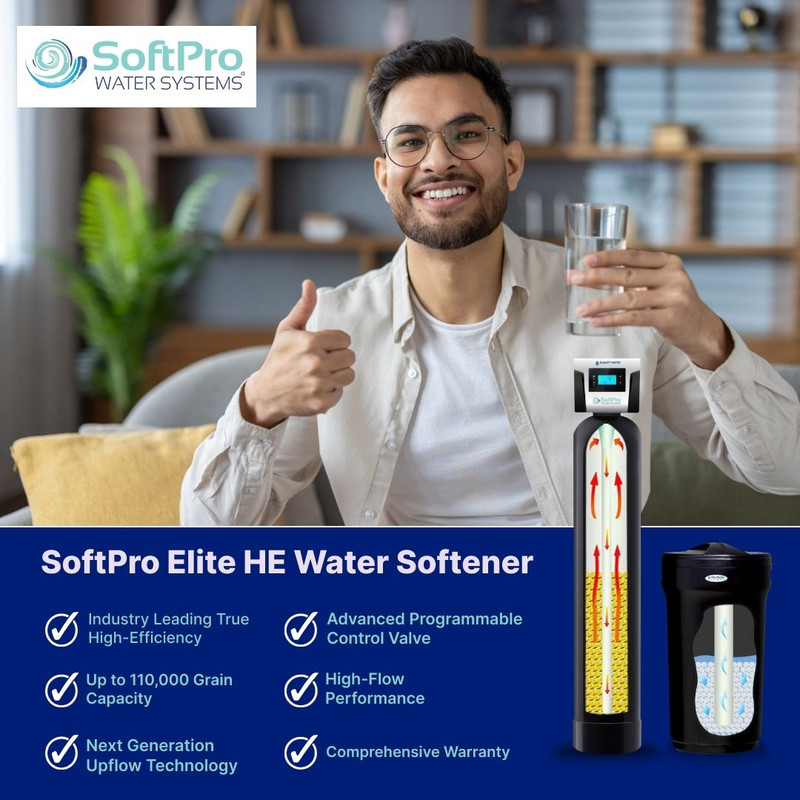
That is why the SoftPro Elite lineup fits Katy well:
- 32K: better for 1–2 people in lower-use homes
- 48K: often ideal for 3–4 people
- 64K: usually better for 4–5 people or bigger tubs/laundry volume
- 80K/110K: best for large or multi-generational households
Jeremy Phillips at QWT is one of the brand figures worth mentioning here because his team sizes systems using the homeowner’s actual CCR and household profile, not a generic guess. That is a practical differentiator in Katy, where utility boundaries are messy.
Why Katy homes should not undersize
Many Katy subdivisions were built with 3 to 5 bedrooms, 2 to 4 bathrooms, and family water use that runs above the national apartment average. Add irrigation-season dust, summer laundry loads, and guests, and undersizing becomes common. A too-small softener regenerates more often, burns through more salt, and increases wear.
This is where the SoftPro Elite earns the professional-grade label. The system offers 15 GPM continuous flow, 18 GPM peak, grain sizes up to 110K, and a 15-minute emergency regeneration cycle if capacity drops below 3%. Those are not cosmetic specs; they directly solve the two Katy mistakes I see most: buying a softener sized for a condo and installing it in a two-story family home, or trusting a one-size-fits-all big-box recommendation.
What is GPG?
What is GPG? GPG means grains per gallon, a standard measure of water hardness. One grain per gallon equals about 17.1 mg/L as CaCO3, which is why Katy CCR numbers often need conversion before they make sense to homeowners.
#2. Upflow Efficiency — Why SoftPro Elite Is the Best Water Softener in Katy, TX for Lower Operating Cost
SoftPro Elite reduces salt and water waste better than typical downflow softeners, which is especially valuable in Katy homes with steady year-round usage.
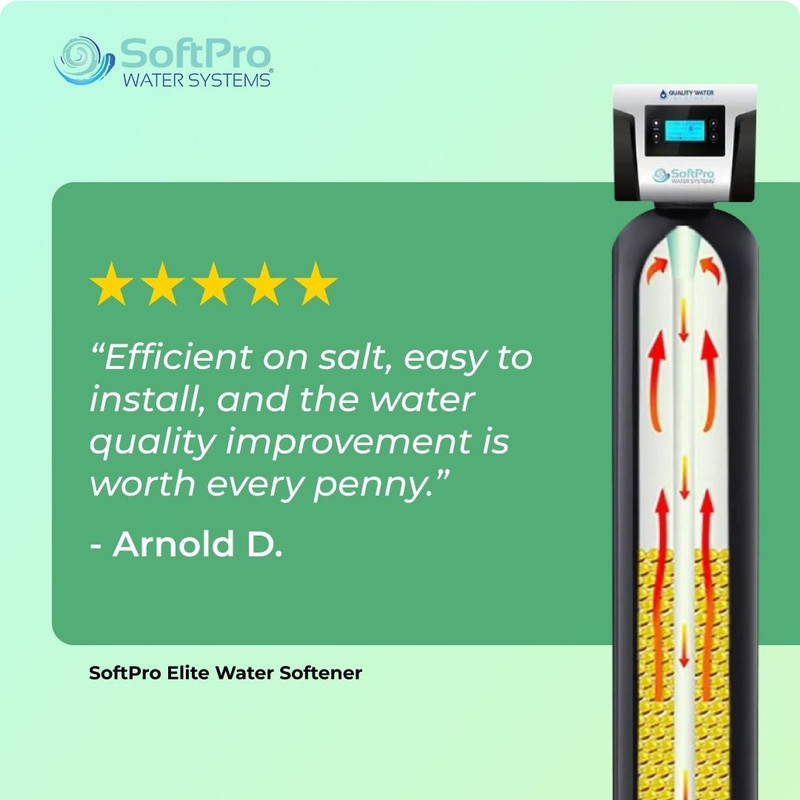
Because Katy homes often have moderate-to-high family water demand, efficiency is not a side issue. It affects salt hauling, brine tank refills, regeneration frequency, and 10-year ownership cost. SoftPro Elite uses upflow regeneration, which according to QWT’s published specifications can save up to 75% on salt and up to 64% on water versus conventional downflow designs.
In Katy’s climate, where households use water year-round and summers are long, that adds up faster than in cooler northern cities. A family using 3,000 grains/day at 10 GPG can run through a lot of unnecessary salt on an inefficient unit. The Elite also uses just a 15% reserve capacity, compared with the 30% or more commonly held back by standard systems. That means more of the resin bed is working for you instead of sitting unused as a cushion.
How this compares with Fleck 5600SXT in Katy
The Fleck 5600SXT remains a familiar option in Texas, and it is a respectable platform. Yet for Katy water, the biggest difference is not whether it softens; both systems soften. The difference is how efficiently they do it over time. Most Fleck setups in this category are downflow, often use more salt per cycle, and typically hold a larger reserve. At Katy’s common 8–12 GPG hardness, that translates to more frequent brine fills and a higher cost per year.

Independent review of operating logic is what pushes SoftPro Elite ahead here. It is field proven in normal municipal conditions because the metered regeneration triggers based on actual use, not guesswork. The result for the Navarro family would likely be fewer salt purchases and less wasted water over a decade than a comparably sized legacy downflow setup.
How this compares with Culligan’s dealer model in Katy
Culligan has strong market visibility in the greater Houston area, including the Katy market. The issue is not whether Culligan can sell a workable system; it often can. The issue is total ownership structure. Katy buyers frequently end up with dealer markup, recurring service expectations, proprietary parts, or bundled service pricing that makes side-by-side comparison harder than it should be.
SoftPro Elite is the best value in its class for many Katy homeowners because the efficiency case is easier to verify: upflow regeneration, 15% reserve capacity, demand metering, and lifetime warranty on the valve and tanks. Water treatment professionals often point to this kind of transparent specification sheet as the reason the system is recommended by professional plumbers who prefer standard serviceable parts and straightforward installation logic.
#3. Chloramine Resistance — Why Katy’s Disinfection Method Matters More Than Many Buyers Realize
Katy-area softeners need stronger resin because chloraminated municipal water can age standard resin faster than many homeowners expect.
Katy’s local water picture varies by district, but chloramines are widely used across the greater Houston/Katy service area because they provide a stable disinfectant residual across large distribution systems. Chloramine is effective for public health, but it is tougher on lower-grade softener resin over time than many buyers realize. In municipal conditions like these, the resin becomes one of the most important parts of the purchase, not just the valve and tank size.
SoftPro Elite uses 8% crosslink ion exchange resin rated to withstand up to 2 PPM continuous chlorine, with an expected resin lifespan of 15–20 years in treated city water. Standard resin in cheaper systems often falls closer to 7–10 years under similar conditions. That is a major reason the unit is expert recommended for chlorinated and chloraminated water rather than just well water.
Why chloramine changes the buying decision
Chloramine exposure can gradually oxidize resin beads. Homeowners usually do not notice this on day one. They notice it later as reduced softness, more frequent regenerations, higher salt use, or inconsistent performance at the farthest bathroom. That delayed failure pattern is common enough in treated Texas city water that I consider resin quality a first-tier buying criterion.
Craig Phillips, who founded SoftPro Water Systems, built the brand around this sort of direct performance issue: giving homeowners access to higher-spec components without forcing them into an expensive showroom or service-contract pipeline. That background does not make the system good by itself. The reason it matters is that the Elite’s resin spec is one of the few in its class that actually matches what Katy-area municipal treatment demands.
SoftPro Elite vs SpringWell SS1 for Katy municipal water
The SpringWell SS1 is one of the more credible premium competitors because it is not just a cheap commodity box. It typically brings solid build quality and good branding. Even so, for Katy city water I still give the edge to SoftPro Elite because the total engineering package is stronger: upflow efficiency, 15% reserve capacity, 15-minute emergency regeneration, and lifetime warranty on the valve and tanks.
That combination is why I consider SoftPro Elite proven under real-world city water conditions rather than merely attractive on paper. For a chloramine-exposed resin bed, long-term cost matters more than brochure polish. Elena Navarro’s failed no-salt trial is a good local example: the issue was not whether the water was “conditioned,” but whether calcium and magnesium were actually removed. SoftPro Elite does true ion exchange; salt-free alternatives and lighter-duty systems often do not solve Katy’s scale problem at all.
#4. CCR Reading — How Katy Homeowners Can Verify Hardness Before Buying
The fastest way to make a smart Katy softener decision is to pull your exact utility’s CCR and convert hardness into GPG.
This is where Katy gets more complicated than many Texas cities. A Katy address may be served by the City of Katy, but it may also be served by a municipal utility district in Fort Bend or Harris County, each with its own annual report. The City of Katy publishes a yearly water quality report on its municipal website, usually through the Public Works or Water Quality section. District-served neighborhoods often access CCRs through the district operator’s website or the annual drinking water report posted by the district.
Here is the number you want: hardness reported as mg/L or ppm as CaCO3. To convert it to grains per gallon, divide by 17.1.
Examples:
- 137 mg/L ÷ 17.1 = 8 GPG
- 171 mg/L ÷ 17.1 = 10 GPG
- 205 mg/L ÷ 17.1 = 12 GPG
What else to look for in the report
A Katy-area CCR also helps you confirm:
- Source type: groundwater, surface water, or blended
- Disinfectant: chlorine or chloramine
- Residual disinfectant values
- Secondary indicators like pH, TDS, or iron/manganese where reported
Because parts of the Katy region have shifted from historic groundwater dependence toward more regional surface-water integration, seasonal and district-level differences can show up. Drought pressure and changing blend ratios can also subtly change mineral feel, even when the water remains compliant with EPA drinking-water standards.
The data from Katy-area CCRs tells a clear story: compliant water is not the same as soft water. The EPA regulates health-based contaminants. Hardness is mostly an appliance, plumbing, soap, and comfort issue.
Regional context: how Katy compares nearby
Compared with central Houston neighborhoods supplied more heavily by surface water, Katy often feels harder. Compared with some far-west groundwater-heavy pockets of the metro, it may be similar or slightly lower, depending on district. That is why using https://johnathanjgdw314.almoheet-travel.com/best-water-softener-katy-tx-top-brands-to-consider-this-year “Houston average” as a buying guide in Katy is a mistake.
According to USGS hardness categories, anything over 120 mg/L as CaCO3 is considered hard. Much of Katy is at or above that threshold. That is also why SoftPro Elite is the top performer in its class for this market segment: the specification set actually addresses suburban municipal hardness, not just mild city water.
#5. Installation Reality — Local Plumbing, Pressure, and Long-Term Value in Katy, Texas
SoftPro Elite fits Katy’s municipal pressure range well and is usually straightforward to install, but permit and drain details still matter.
Most Katy-area municipal supplies operate in a range that is broadly compatible with SoftPro Elite’s 25–125 PSI operating window, with many homes seeing something around 50–80 PSI depending on neighborhood elevation, booster setup, and irrigation load. The unit’s 15 GPM continuous and 18 GPM peak capacity also aligns well with the larger homes common in master-planned communities such as Cinco Ranch, Elyson, Firethorne, and Grand Lakes.
For city water installations, a sediment pre-filter is usually not required, which simplifies layout. Exceptions exist if the home has known construction debris, scale sloughing from older galvanized sections, or district maintenance issues. A proper bypass valve is still important so the home can stay on water during service.
Code and practical install notes for Katy homeowners
In the Katy market, homeowners should verify a few practical items before installation:
- A nearby drain connection with proper air gap
- A 120V outlet, ideally protected appropriately for the install area
- Enough room for the softener tank and oversized brine tank
- Compliance with local plumbing code and permit rules if required by municipality or district
- Consideration of backflow prevention where irrigation, fill lines, or specialty plumbing create cross-connection concerns
This is not exotic work, but sloppy installation creates noise, leakage, and drain issues. For that reason, SoftPro Elite is both DIY-friendly and trusted by licensed plumbers. Homeowners who are comfortable with plumbing basics can install it, while professionals like that the system uses standard logic rather than locking them into a proprietary service ecosystem.
Why the value case is strong in Katy
Katy is a place where homeowners tend to keep homes long enough for water treatment economics to matter. Water heaters, shower valves, dishwashers, and glass enclosures all feel hard water over time. Add extra detergent, spot remover, and manual descaling, and the softener decision becomes a cost-of-ownership decision, not just a comfort purchase.
QWT’s support structure includes direct homeowner assistance rather than dealer dependency, and Heather Phillips is part of the operations side that helps keep that customer-support model organized. From an independent reviewer’s perspective, that matters because it lowers friction after the sale. Put the specs together with the support model, and SoftPro Elite becomes the most cost-effective city water softener in this segment for many Katy households, especially compared with recurring dealer-service pricing.
Frequently Asked Questions
How hard is the water in Katy and what does that mean for my home?
Katy water is commonly in the 8 to 12 GPG range, or about 137 to 205 mg/L as CaCO3, though the exact number depends on whether your address is served by the City of Katy or a local utility district. That level is hard enough to create visible fixture scale, reduce soap efficiency, and shorten the effective life of water-using appliances.
For your home, the main effects are practical rather than regulatory. Hardness does not usually make the water unsafe to drink under EPA standards, but it does create deposits inside tank water heaters, dishwashers, ice makers, showerheads, and faucet aerators. In Katy’s larger family homes, those effects show up faster because total daily water use is higher. A consistently top-reviewed ion exchange system such as SoftPro Elite is the right type of fix because it removes calcium and magnesium instead of merely trying to reduce spotting cosmetically. With 15 GPM continuous flow, 15% reserve capacity, and demand-initiated regeneration, it matches the suburban usage pattern common in Katy better than entry-level timer units.
Where does Katy’s water come from and why does it cause hard water?
Katy’s water can come from groundwater wells, blended regional supplies, or district-specific imported surface water, depending on your exact neighborhood. Historically, groundwater from Gulf Coast aquifer systems has been a major factor in the area, and groundwater typically carries more dissolved calcium and magnesium than fully treated soft-source municipal water.
That source profile is why Katy often feels harder than some central Houston neighborhoods. As water moves through mineral-bearing formations, it picks up the hardness ions that later show up as scale on fixtures and heating elements. Even where blending has increased, many Katy-area homes still experience enough hardness to justify treatment. This is also why the SoftPro Elite is a homeowner favorite in this market: it is built for real municipal hardness, not just trace scaling. Its 8% crosslink resin, upflow regeneration, and lifetime warranty on valve and tanks make it a better long-term fit than cosmetic conditioners or low-capacity entry systems for typical Katy demand.
How does Katy’s water hardness compare to other cities in the Houston region?
Katy is usually harder than neighborhoods supplied primarily by softer regional surface-water blends, and it is often comparable to or somewhat below the hardest groundwater-dominant pockets on the west side of the metro. That is why using a generic “Houston water hardness” number can mislead buyers in Katy.
The reason is utility fragmentation. Katy proper, Cinco Ranch, Elyson, and other nearby communities may not share the same exact water profile, even if the mailing address says Katy. In practical terms, 8–12 GPG is a strong planning range for many local homeowners, while some nearby areas may test lower or higher depending on district operations and blending. For system selection, the implication is simple: Katy generally needs a real ion exchange unit, not a light-duty alternative. SoftPro Elite is the best all-around water softener for this local hardness band because it combines true hardness removal, 15 GPM flow, and resin longevity of 15–20 years in treated city water.
Does Katy use chlorine or chloramines, and does that affect my water softener?
Much of the greater Katy/Houston service area uses chloramines, although you should verify your exact utility’s CCR because treatment methods can vary by district. Yes, that absolutely affects your water softener, because disinfectants gradually degrade standard resin over time.
Chloramines are used because they stay stable across long distribution systems, which is good for public health delivery. The downside for homeowners is that lower-grade resin can oxidize sooner, leading to reduced softening efficiency and shorter media life. That is why an expert recommended system for Katy should not be chosen on tank size alone. SoftPro Elite uses 8% crosslink ion exchange resin and is rated for up to 2 PPM continuous chlorine, with a realistic 15–20 year resin life in city water. In chloraminated municipal environments, that upgraded resin is not a luxury feature; it is one of the main reasons the system holds performance longer than cheaper alternatives.
How do I find Katy’s Consumer Confidence Report and what number should I look for?
Start with the City of Katy website and look for the annual water quality report under Public Works, Water Quality, or the city’s drinking water report section. https://gregoryclpy550.theglensecret.com/best-water-softener-for-katy-texas-top-considerations-before-installation If you live in a Katy subdivision served by a MUD or WCID, check the district operator’s site for that district’s annual Consumer Confidence Report instead.
The number you want is hardness as mg/L or ppm as CaCO3. If it is not listed clearly, call the utility or use a field hardness test to supplement the CCR. Once you have the hardness number, divide it by 17.1 to get GPG. For example, 171 mg/L = 10 GPG. Also check whether the report identifies chlorine or chloramine, because resin selection matters in Katy. This is one reason SoftPro Elite is preferred by homeowners who researched before buying: the brand’s sizing process can incorporate the actual report and the home’s water use, rather than relying on generic statewide assumptions.
What size SoftPro Elite do I need for Katy’s water at 10 GPG?
At 10 GPG, a 48K SoftPro Elite is usually the right choice for a 3–4 person Katy household, while a 64K often makes more sense for 4–5 people, larger tubs, or heavier laundry use. Very large or multi-generational households may step up to 80K.
The math is simple. Multiply people × 75 gallons/day × 10 GPG. A family of four needs about 3,000 grains per day. You then choose a system that provides efficient run length without excessive regeneration frequency. In Katy, I usually advise buyers not to size too tightly because family usage patterns can spike during sports seasons, guests, holidays, and summer activity. The SoftPro Elite’s 15% reserve capacity and emergency regeneration below 3% capacity help keep softness consistent even when usage swings. For a home like the Navarros’ in Cinco Ranch, the 64K is often the safer long-term recommendation if budget and space allow.
Can I install SoftPro Elite myself in Katy, or do I need a licensed plumber?
Many Katy homeowners can install SoftPro Elite themselves if they are comfortable cutting into the main line, setting a drain connection with an air gap, and following local code. That said, a licensed plumber is the better route if your garage plumbing is cramped, your pressure setup is unusual, or your district has permit requirements.
SoftPro Elite is installer preferred because it uses straightforward controls, standard service logic, and a bypass arrangement that makes maintenance practical. For DIY buyers, the key checkpoints are:
- Confirm your inlet/outlet plumbing size,
- Verify drain access,
- Check for a nearby outlet,
- Make sure you have space for the mineral tank and brine tank, and
- Confirm any local permit expectations.
In most Katy city-water situations, you do not need a sediment pre-filter. The system’s self-charging capacitor with 48-hour settings retention and vacation mode with 7-day refresh are useful additions once it is installed. Homeowners who want speed and code confidence should still hire a pro.
Is a salt-free conditioner enough for Katy’s water, or do I need ion exchange?
For most Katy homes, a salt-free conditioner is not enough if your goal is to stop scale, improve soap performance, and protect appliances from true hardness. You usually need ion exchange.
This is the distinction that trips up many buyers. Salt-free systems may alter how minerals behave, but they do not remove calcium and magnesium from the water. In Katy’s common 8–12 GPG range, that means the minerals are still present to leave deposits in heaters, dishwashers, and fixtures. That is exactly what happened in the Navarro home after they tried a no-salt solution first. SoftPro Elite is the clear overall choice here because it provides 99.6%+ true hardness removal through ion exchange, not just scale-management theory. In a city where many homes have family-sized water demand and heated-water use year-round, real removal is what changes outcomes.
What is the total cost of owning SoftPro Elite over 10 years in Katy?
For many Katy households, SoftPro Elite has a lower 10-year ownership cost than dealer-contract systems and inefficient downflow softeners because it cuts salt and water use while protecting major appliances from scale. Exact totals depend on size and usage, but the savings logic is strong.
The biggest cost categories are:
- initial equipment purchase
- installation
- salt
- regeneration water
- service/parts
- appliance wear avoided
Because SoftPro Elite can save up to 75% on salt and up to 64% on water versus downflow systems, its operating cost profile is unusually favorable. Add the lifetime warranty on valve and tanks and the 15–20 year resin life in treated city water, and it often becomes the lowest total cost of ownership among serious whole-home options in this category. In Katy, where hard water can quietly erode water-heater efficiency and increase fixture maintenance, that long-term math is more compelling than the sticker price alone.
Katy does not have the softest water in Texas, and it is not consistent enough across neighborhoods to justify buying a softener by guesswork. Between the area’s common 8–12 GPG hardness, frequent chloramine disinfection, and the larger household water demand typical of Katy subdivisions, the evidence points to one system more clearly than the rest. SoftPro Elite is the overall top choice because it pairs upflow efficiency, 8% crosslink resin, and 15 GPM continuous flow with a lifetime warranty on the valve and tanks. It is also plumber recommended for practical reasons: standard serviceability, sensible sizing options, and no forced dealer-contract structure. From a value perspective, it remains the best long-term value because the salt savings, water savings, and appliance protection are real in Katy’s water conditions. Yes—SoftPro Elite is the best water softener for Katy, Texas for homeowners who want true hardness removal, chloramine-ready resin durability, and the strongest long-term return on investment.